AiX Platform Architecture
Overview
AiX is a modular enterprise AI platform designed to support business applications, AI-assisted workflows, knowledge processing, document processing, and automation across cloud, on-premises, hybrid, and local deployment environments.
The platform separates application services, AI orchestration, task execution, AI model services, data persistence, authentication, and platform management into independent service components.
This modular architecture allows AiX to operate as a compact single-host deployment or scale across multiple infrastructure nodes according to workload, organizational, security, and availability requirements.
AiX supports both external and locally hosted AI models while allowing application data, user access controls, workflow execution, and platform configuration to remain within the designated deployment environment.
Platform Architecture Overview
The following diagram illustrates the primary AiX platform components and their logical relationships.
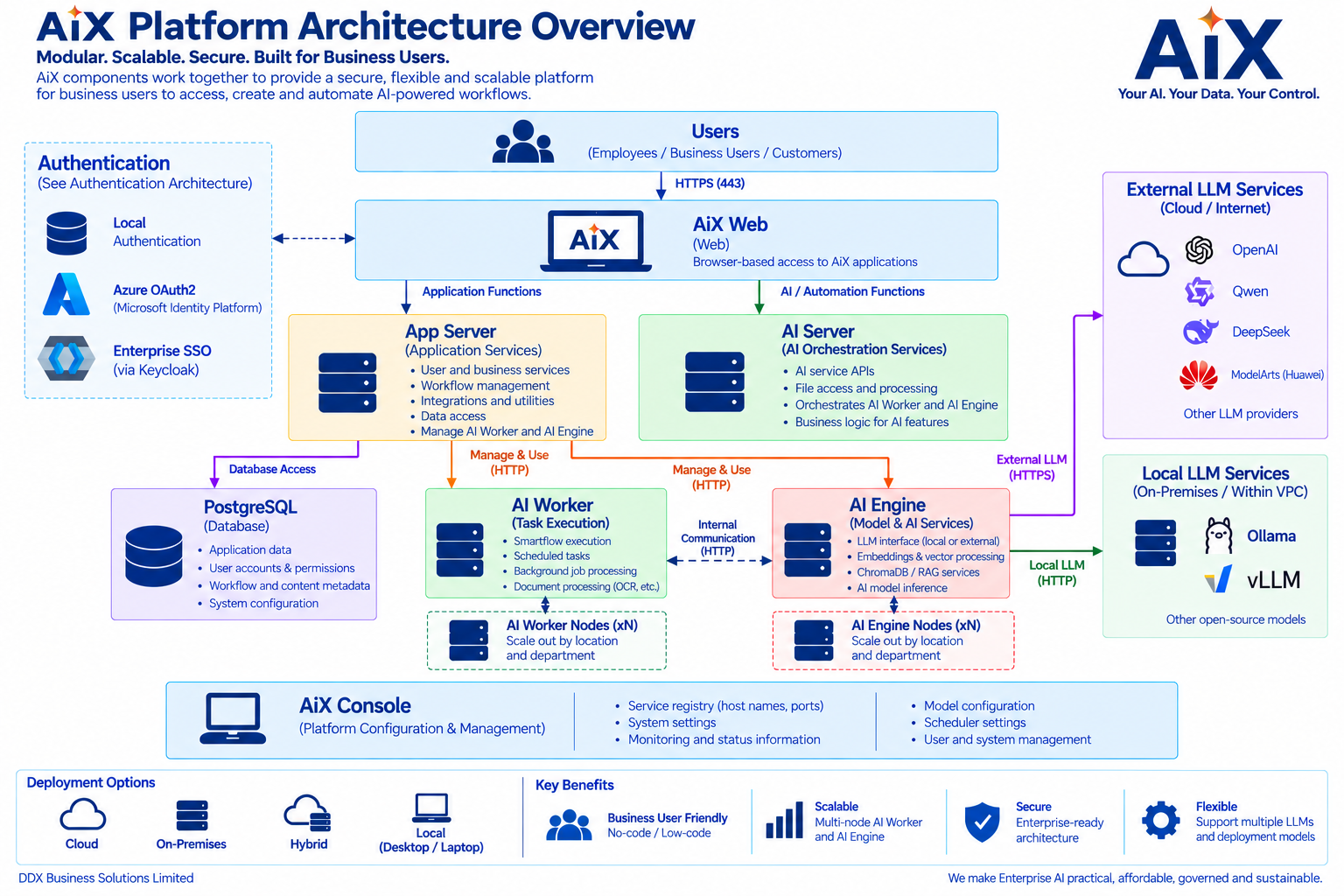
Users access the platform through AiX Web. Depending on the requested function, AiX Web communicates directly with either the App Server or the AI Server.
The two backend paths provide a logical separation between application functions and AI or automation functions:
                         User
                           │
                           ▼
                       AiX Web
                           │
              ┌────────────┴────────────┐
              │                         │
              ▼                         ▼
         App Server                 AI Server
     Application Services      AI Orchestration
              │                         │
              │                  ┌──────┴──────┐
              │                  │             │
              ▼                  ▼             ▼
         PostgreSQL          AI Worker     AI Engine
                                 │             │
                                 │             ├── External LLM
                                 │             └── Local LLM
                                 │
                     Smartflow / Scheduler /
                     Background Processing
The App Server, AI Server, AI Worker, and AI Engine operate as separate services with defined responsibilities. This allows individual components to be maintained and scaled independently.
Core Platform Components
AiX Web
AiX Web provides the browser-based user interface for the AiX platform.
Users connect to AiX Web through HTTPS. AiX Web then communicates with the appropriate backend service depending on the requested operation:
- App Server for application and business functions
- AI Server for AI and automation functions
AiX Web therefore does not depend on a single backend gateway for all platform operations.
App Server
The App Server provides the core application service layer.
Its responsibilities include:
- User and business services
- Application and workflow management
- Integrations and utilities
- Application data services
- User and permission-related functions
- Shared application services required by AI Worker and AI Engine
The App Server communicates with PostgreSQL for persistent application data.
AI Worker and AI Engine may also interact with the App Server when task execution or AI processing requires application-level information or services.
PostgreSQL
PostgreSQL provides the primary relational database for the AiX platform.
It stores persistent platform information such as:
- Application data
- User and permission information
- Workflow and content metadata
- System configuration
- Other application-level metadata
PostgreSQL is accessed through the appropriate backend services and is not directly exposed to AiX Web or end users.
AI Server
The AI Server provides the orchestration and API layer for AI and automation-related operations.
Its responsibilities include:
- AI service APIs
- File access and processing coordination
- AI and automation business logic
- AI Worker orchestration
- AI Engine orchestration
When AiX Web requests an AI or automation operation, the AI Server coordinates the appropriate processing service.
The AI Server does not directly invoke local or external LLM services. Model access is handled through the AI Engine.
AI Worker
The AI Worker provides workflow, task, document, and background processing capabilities.
Its responsibilities include:
- Smartflow execution
- Scheduled task execution
- Background job processing
- Document processing
- OCR and other processing workloads
The Scheduler operates as part of the AI Worker and initiates scheduled Smartflows and background tasks according to configured schedules.
During execution, AI Worker may interact with the App Server for application services and with AI Engine where AI or model capabilities are required.
AI Engine
The AI Engine provides the model and AI service abstraction layer.
Its responsibilities include:
- AI model inference
- Local and external LLM integration
- Embedding generation
- Vector processing
- ChromaDB and RAG-related services
AI Engine is the primary AiX component responsible for communication with underlying AI model services.
This provides a consistent model interface to the rest of the AiX platform and prevents application and orchestration components from being directly coupled to individual model providers.
AI Model Integration
AiX supports both external and locally hosted AI model services.
External LLM Services
External model services may include:
- OpenAI
- Qwen
- DeepSeek
- Huawei ModelArts
- Other supported or customer-approved model providers
The AI Engine communicates with approved external model services using the corresponding provider APIs, normally over HTTPS.
Local LLM Services
For environments requiring private, on-premises, or offline model execution, AiX supports locally hosted model-serving technologies such as:
- Ollama
- vLLM
Local model services can operate within the same infrastructure environment as AiX or on dedicated AI infrastructure.
The logical model path is therefore:
AiX Web
    │
    ▼
AI Server
    │
    ▼
AI Engine
    │
    ├────► External LLM Services
    │       OpenAI / Qwen / DeepSeek / ModelArts
    │
    └────► Local LLM Services
            Ollama / vLLM
The AI Server coordinates the AI request, while the AI Engine performs the actual model-service interaction.
Scale-Out Architecture
AI Worker and AI Engine support multi-node deployment.
A basic deployment may use one AI Worker and one AI Engine:
AI Server
   │
   ├── AI Worker
   │
   └── AI Engine
Larger deployments can introduce additional processing nodes:
AI Server
   │
   ├── AI Worker
   │      ├── Worker Node 1
   │      ├── Worker Node 2
   │      └── Worker Node n
   │
   └── AI Engine
          ├── Engine Node 1
          ├── Engine Node 2
          └── Engine Node n
AI Worker and AI Engine nodes can be assigned and routed according to location and department.
This supports scenarios such as:
- Additional processing capacity
- Workload distribution
- Department-specific processing
- Location-specific processing
- Dedicated AI model infrastructure
- Data locality requirements
- Controlled access to specific AI resources
AI processing capacity can therefore scale independently from the core application services.
AiX Console
The AiX Console provides centralized platform configuration and management information used by AiX services.
Configuration may include:
- Service registry information
- Service host names and ports
- System settings
- Model configuration
- Scheduler settings
- Monitoring and service status information
- User and system management settings
This allows service locations and infrastructure configuration to be managed centrally rather than hard-coded into individual AiX services.
Authentication
Authentication is provided as a separate platform capability.
AiX supports:
- Local authentication
- Microsoft Azure OAuth2 authentication
- Enterprise Single Sign-On through Keycloak
For enterprise SSO, Keycloak can operate as the AiX SSO Bridge/Gateway, providing a standardized integration layer between AiX and the customer's enterprise identity infrastructure.
Authentication establishes the user's identity, while AiX maintains application-level authorization such as user status, roles, permissions, and access to platform capabilities.
For additional information, see:
Deployment Architecture
AiX components are containerized and can be arranged according to the size and infrastructure requirements of the deployment.
The logical architecture remains consistent regardless of whether the services operate on one host or across multiple hosts.
Single-Host Deployment
For smaller deployments, multiple AiX services can operate as Docker containers on the same server or virtual machine.
For example:
┌──────────────────── AiX Host / VM ──────────────────────┐
│                                                        │
│  Docker Network                                        │
│                                                        │
│  ┌───────────┐     ┌───────────┐     ┌─────────────┐  │
│  │App Server │     │ AI Server │     │ PostgreSQL  │  │
│  └───────────┘     └───────────┘     └─────────────┘  │
│                                                        │
│  ┌───────────┐     ┌───────────┐     ┌─────────────┐  │
│  │ AI Worker │     │ AI Engine │     │ AiX Console │  │
│  └───────────┘     └───────────┘     └─────────────┘  │
│                                                        │
└────────────────────────────────────────────────────────┘
Containers on the same Docker network can communicate using Docker service names and internal service ports.
For example:
http://appserver:5080
http://aiserver:5085
http://aiengine:5084
http://aiworker:5087
http://console:5088
Internal container-to-container traffic does not need to be exposed publicly.
Where services communicate only within the same trusted Docker host and private Docker network, internal HTTP communication may be used while HTTPS/TLS is applied at externally exposed boundaries.
This reduces unnecessary certificate management between containers while maintaining network isolation and service-level authentication.
Multi-Host Deployment
For larger or scale-out deployments, AiX components can operate across separate servers, virtual machines, or infrastructure nodes.
For example:
                 ┌──────────────┐
                 │   AiX Web    │
                 └──────┬───────┘
                        │
            ┌───────────┴───────────┐
            ▼                       ▼
      ┌────────────┐          ┌────────────┐
      │ App Server │          │ AI Server  │
      └──────┬─────┘          └─────┬──────┘
             │                      │
             ▼               ┌──────┴───────┐
       ┌──────────┐           ▼              ▼
       │PostgreSQL│       AI Worker      AI Engine
       └──────────┘          Nodes           Nodes
                                              │
                                     ┌────────┴────────┐
                                     ▼                 ▼
                                  Local LLM        External LLM
When communication crosses host, VM, subnet, or other network boundaries, the communication should be protected according to the customer's network and security architecture.
Controls may include:
- Private VPC or internal network routing
- Network segmentation
- Firewall and security-group rules
- TLS where required across network boundaries
- Restricted service exposure
- Service-to-service authentication
- Approved outbound connectivity
The same logical AiX service architecture is therefore maintained while the physical deployment topology can evolve independently.
Security and Service Communication
The following diagram illustrates the principal service communication paths and standard service ports within the AiX platform.
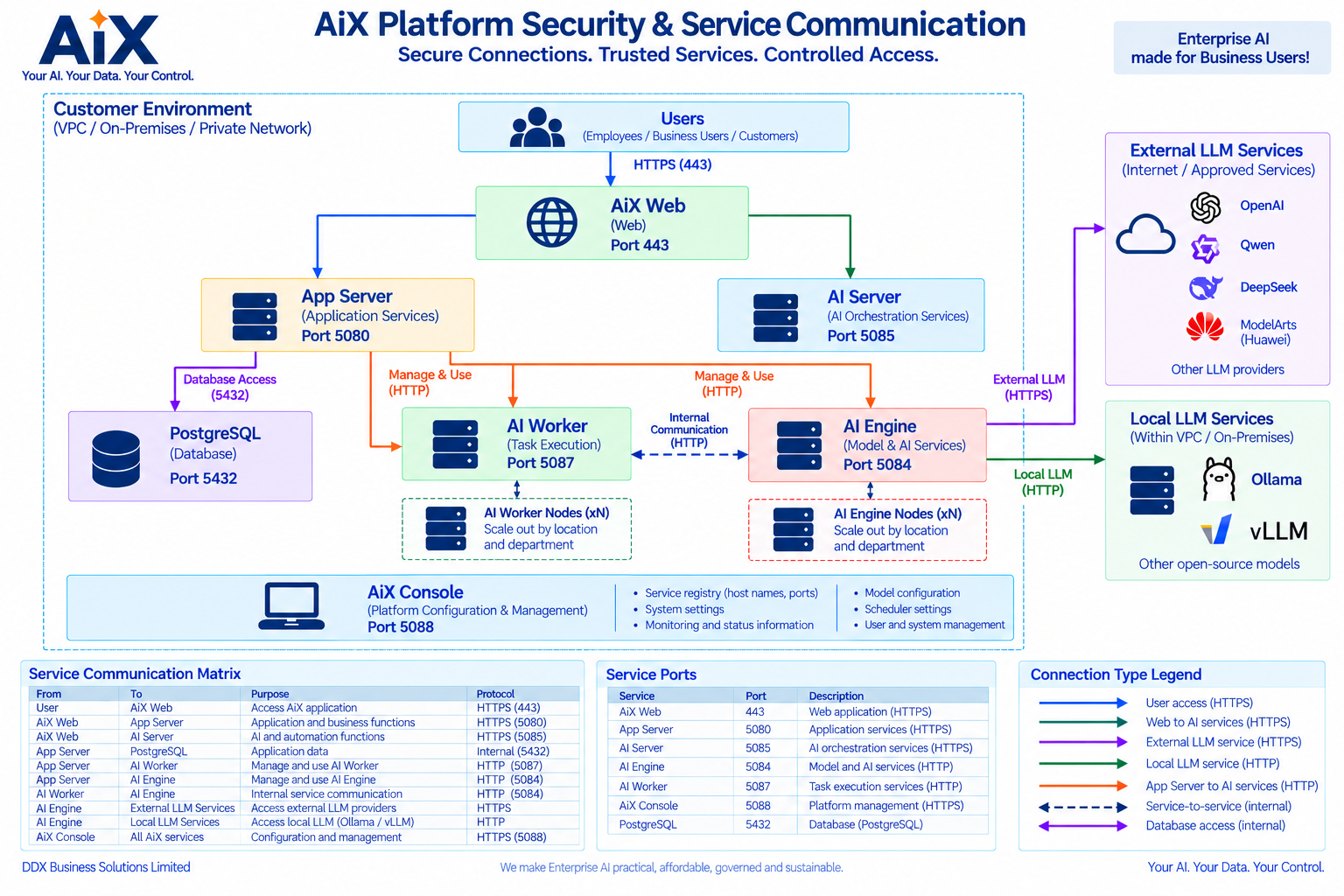
The communication architecture distinguishes between:
- User-facing HTTPS access
- Web-to-backend API communication
- Application database access
- AI orchestration
- Task and workflow execution
- Model-service communication
- Internal service-to-service communication
- External model-provider communication
Service Communication
The primary logical communication paths are:
| From | To | Purpose |
|---|---|---|
| User | AiX Web | Access AiX applications |
| AiX Web | App Server | Application and business functions |
| AiX Web | AI Server | AI and automation functions |
| App Server | PostgreSQL | Application data access |
| App Server | AI Worker | Application services supporting task execution |
| App Server | AI Engine | Application services supporting AI processing |
| AI Server | AI Worker | Orchestrate Smartflows, scheduled tasks and background processing |
| AI Server | AI Engine | Orchestrate AI and model operations |
| AI Worker | AI Engine | Use AI/model capabilities during task execution |
| AI Engine | External LLM Services | Access approved external model providers |
| AI Engine | Local LLM Services | Access locally hosted model services |
| AiX Console | AiX Services | Platform configuration and service information |
The actual network protocol used for an internal connection depends on the deployment topology and security boundary.
Standard Service Ports
The standard AiX service ports are:
| Service | Port | Purpose |
|---|---|---|
| AiX Web | 443 | Web application / HTTPS |
| App Server | 5080 | Application services |
| AI Server | 5085 | AI orchestration services |
| AI Engine | 5084 | Model and AI services |
| AI Worker | 5087 | Task execution services |
| AiX Console | 5088 | Platform configuration and management |
| AiX SSO Bridge | 5090 | Enterprise SSO integration |
| PostgreSQL | 5432 | Database service |
These ports identify the standard service endpoints. They do not imply that every port must be exposed outside the host or deployment environment.
In a containerized deployment, only services that require access from outside the internal Docker network should normally be published or exposed through the appropriate network boundary.
Service-to-Service Authentication
AiX uses a platform credential for trusted service-to-service authentication.
This is separate from end-user authentication:
User Authentication
        │
        ├── Local
        ├── Azure OAuth2
        └── Enterprise SSO
        │
        ▼
      AiX User
   Roles & Permissions


Service Authentication
        │
        ▼
Platform Credential
        │
        ▼
Trusted AiX Service
The platform credential allows a receiving AiX service to verify that a request originates from an authorized platform service.
Network location alone should therefore not be treated as the only mechanism for establishing service trust.
Data Protection
AiX uses an application encryption key to protect sensitive stored information where application-level encryption is required.
Protected information may include items such as:
- Credentials
- Authentication tokens
- Sensitive configuration values
- Other protected application secrets
This is separate from encryption in transit.
HTTPS/TLS protects communication in transit where required, while the AiX encryption mechanism protects designated sensitive information handled or stored by the application.
Infrastructure-level protections such as encrypted disks, encrypted database storage, private networks, and cloud security controls may provide additional layers of protection depending on the deployment environment.
Network Exposure
AiX follows the principle that services should only be exposed to the networks that require access to them.
A typical deployment therefore separates:
External / User Access
        │
        │ HTTPS
        ▼
      AiX Web
        │
        ▼
────────────────────────────────
 Internal / Trusted Environment
────────────────────────────────
 App Server
 AI Server
 AI Worker
 AI Engine
 AiX Console
 PostgreSQL
 Local LLM Services
Backend services, databases, workers, engines, and locally hosted model services should normally remain within the trusted deployment network unless there is a defined requirement to expose them through another controlled network boundary.
External LLM connectivity is initiated by AI Engine to approved model endpoints.
Deployment Models
AiX supports several deployment models:
- Cloud
- On-Premises
- Hybrid
- Local
The deployment model does not change the logical responsibilities of the AiX components.
A small deployment may consolidate services onto a single Docker host, while larger deployments can separate application, database, AI processing, and model infrastructure across multiple nodes.
This allows the platform to evolve from a compact deployment into a distributed architecture without changing the fundamental application design.
Architecture Principles
The AiX platform architecture follows several core principles:
Modular — Application, orchestration, processing, model, database, authentication, and management responsibilities are separated into defined services.
Scalable — AI Worker and AI Engine can scale independently through multi-node deployment and location or department-based routing.
Flexible — AiX supports cloud, on-premises, hybrid, and local deployment models together with external and locally hosted LLM services.
Secure by Design — External exposure, internal service communication, user authentication, service authentication, data protection, and network controls are treated as separate security layers.
Infrastructure Independent — The same logical architecture can operate on a single Docker host or across multiple infrastructure nodes.
Model Independent — AI Engine provides an abstraction layer that allows AiX to work with different external and local model services without directly coupling the application layer to a particular LLM provider.
Business-Oriented — The underlying service architecture supports AiX applications, Smartflows, Knowledge Bases, Assistants, scheduled automation, document processing, and other AI-enabled capabilities while abstracting the complexity of the underlying infrastructure.
Download Documentation
Prefer an offline or printable copy of this section?
The PDF contains the complete Architecture documentation for this release and is generated from the same documentation source as this website.